Agentic AI: what's really under the hood
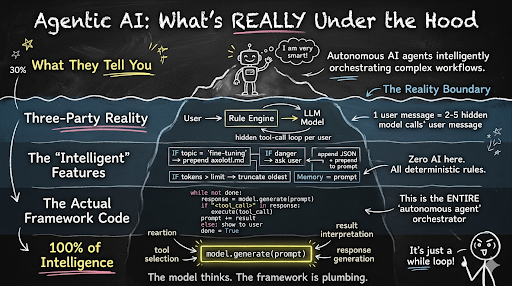
Table of Contents
Today I learned the cleanest way to see through the agentic AI hype: the model thinks, the framework is plumbing.
The tip of the iceberg (30%)
“Autonomous AI agents intelligently orchestrating complex workflows.” That’s the story you’re sold — a robot that’s very smart. Cute.
Below the waterline (the other 70%)
A three-party reality. It’s not you → the agent. It’s User → Rule Engine → LLM Model, running a hidden tool-call loop. One user message quietly becomes 2–5 model calls.
The “intelligent” features are deterministic. Memory? IF tokens > limit → truncate oldest. Danger? IF danger → ask user. Context? IF topic = 'fine-tuning' → prepend the fine-tuning guide. Zero AI here — all plain if-statements.
The entire orchestrator is this:
while not done:
    response = model.generate(prompt)
    if "<tool_call>" in response:
        execute(tool_call)
        prompt += result
    else:
        show_to_user(response)
        done = True
Tool selection, result interpretation, response generation — every “agentic” capability maps back to that loop. 100% of the intelligence is in model.generate(prompt), the one yellow box.
The transferable win
When you read “autonomous agent,” translate it in your head: a while loop + some if-statements wrapped around an LLM call. The cleverness is in the model and the prompt — the orchestration is plumbing. That reframing tells you where to spend your effort (model + prompt quality, not clever framework choreography) and where not to be impressed by marketing.